When I wrote about new beginnings in July, I thought summer would bring with it an opportunity to explore parts of the peninsula I hadn’t visited before. I had grand hiking plans: I’d follow Clachaig Water to the long-abandoned farmstead of Achahoirk just to see if I could make it without sinking into a bog, for example, or head up into the middle of Kintyre, beyond the forestry land, to view Arran from the summit of the highest point.
It was a Saturday, cool and overcast, when I made my pledge to write again. I explained where I’d been, what I’d done, and why I’d returned, ice floes on a lake, life shifting. Just a little earlier that day, my youngest daughter, Juliette, had complained of an earache while getting herself a glass of milk in the kitchen. “Oh, dear,” I thought. “That’s typical — an ear infection at the weekend.”
Fewer than four days later, I’d be more than a hundred miles away by road in a private room, staring at an empty hospital bed.
Instincts and liminal spaces
“Trust your instincts,” they say. “They won’t let you down.”
Unfortunately, that doesn’t mean other people will take your word for it when they’re told something’s seriously wrong with your child.
Juliette woke up on Sunday the 5th of July with a splitting headache. That, in itself, was unusual. She isn’t prone to headaches, even when ill. After being sick a couple of times, she managed a little bit of lunch — but her ear hurt, and she had quite a high fever.
I began alternating ibuprofen and paracetamol, but the headache never really went away. About 10.00 o’clock that evening, the area behind her left ear felt tender to the touch and maybe a little pink, but not swollen, and I thought seriously about taking her to A&E rather than waiting until morning for the doctor. In the back of my mind, I wondered if she’d developed mastoiditis — but she felt tired, and I suspected we’d be dismissed after an hours-long wait with instructions to keep giving her medicine. “Most ear infections are viral,” they usually say, “and will burn themselves out in three days.”
On Monday, her headache continued. She sat, quiet and pale, on the sofa, drinking vast amounts of water but eating almost nothing. I watched her, worrying.
We went to the doctor. “She has an earache and an intractable headache,” I explained, sweeping her hair back with my fingers, “and she says this area, right behind her ear, hurts when I touch it.” I told him she’d been sick the previous day, and that she’d had a fever since Saturday.
The doctor frowned, peered at the place I’d pointed out, and used an otoscope to look into her ear.
“I can’t see the eardrum,” he said. “Her ear canal is full of wax.” He explained that wax could cause pain, but that the NHS didn’t syringe ears anymore. Apparently I could take her to the nearest larger town and get it done privately there, but it would cost in the region of £70.
“Does ear wax cause a temperature of 39.5ºC?” I asked, looking pointedly at the doctor.
“Well, no,” he replied.
We left with a prescription for wax-softening ear drops and Nystatin for a “coated tongue.” Driving home, I felt helpless and uneasy.
___
That night, Juliette slept in my bed. I wanted her near me because I knew something wasn’t right.
At about 4.00 o’clock the next morning, she woke up, shaking with fever, and was sick all over the place. I comforted her, changed the sheets, and tucked her back in — but it quickly became clear that she couldn’t stop throwing up, and I began counting the hours. Eight hours, you see, is the threshold at which you’re supposed to seek medical help if you can’t keep anything down.
By 11.20 am, her vomiting had turned from ordinary to projectile. Her head was pounding. “What is this illness?” she shouted, crying. I rang the doctor. After initially suggesting I take her to A&E, they called her into the surgery.
I threw my iPad and few overnight supplies for us both into my rucksack, and tucked Flopsy — Juliette’s favourite plushie — into the bungee cords on the back. Then, I wrapped Juliette in her dressing gown, picked her up, and carried her to the car.
This time, we saw a different doctor — a locum from South Yorkshire who took the look of alarm in my eyes very seriously indeed. After examining Juliette, she confirmed that we’d need to go “up the road” to the hospital, and called ahead to brief the children’s emergency department. Having waited hours for an ambulance in April (again, for Juliette — another story for another time), I decided I would drive her over myself.
“Will you be okay? Do you have anyone to go with you?” asked the doctor.
“No — but I’ll be alright. I’ll go straight there,” I replied.
She gave me a hug on the way out. “You scare me,” she said.
The wind felt wild as I carried Juliette through the surgery car park — gusty, hot, as if the weather knew something was afoot. I strapped her into her seat and put a towel over her lap. She looked at me, pallid and impassive. “I love you,” I said, and shut the door.
We passed our home in the village and drove northward along the trunk road. I felt completely alert and aware of how serious the situation had become: I had to get her there as quickly and safely as possible.
There was something else in my mind, though — a creeping sensation I couldn’t shake. I looked back at Juliette in the rear-view mirror, pushing my body up to see her face, and began to wonder if she was dying. She closed her eyes and held on to the moulded pulp bowl we’d been given for the journey from the doctor’s office. Her lips were almost white. The skin on her forehead seemed to fade into her pale blonde hair.
Music suddenly felt important. No longer confident we’d get to the hospital in time, I wanted to play something beautiful for Juliette to make her feel less afraid. We flew along with an album by A Winged Victory for the Sullen on the stereo. By the time we reached Lomondgate, our ambient playlist had melted into Madison Cunningham’s “Life According to Rachael”, and I sang along in resistance to the growing feeling of fear in my chest.
It’s not if, darling, it’s when.
There’s always something left unsaid.
Were your eyes green; were they blue?
What was it that I forgot to ask you?
Standing at the threshold
It took us about three hours to get from our village to the Royal Hospital for Children in Glasgow. I pulled into the tiny car park next to the maternity unit entrance at about 5.30 pm and found one spot open, right at the back.
By this time, Juliette was semi-conscious and certainly couldn’t walk, so I put my coat and rucksack on — Flopsy dangling out of her precarious cradle — and wrapped my arms around the dead weight of my daughter, carrying her from the car to the children’s A&E entrance. A nurse caught us as we came through the automatic doors and quickly found a wheelchair.
After taking her temperature (by then well over 40ºC), the nurse gave her some paracetamol to bring her fever down, but it came straight back up again in the waiting room. Thankfully, we were taken to the intake area almost immediately and put behind a curtain. I lifted Juliette from her curled position in the wheelchair, laid her on the bed, and made a blanket of her dressing gown.
Our little space quickly became a hub of activity. On one side, two nurses took blood, inserted a cannula, administered paracetamol by infusion, put on a blood pressure cuff, and connected an oxygen monitor; on the other, a doctor spoke with me about her symptoms. Nearby, I heard small children crying, speaking, laughing. Meanwhile, Juliette lay still, barely reacting to needles, noises, or any of the various tests they were performing on her little body.
Shortly after 7.00 pm, they pushed four enormous syringes full of fluid into her cannula, followed by a large dose of antibiotics. I sat in a blue plastic chair next to the bed, helping the nurses whenever I could. Juliette’s face had begun to twitch in an odd way. One of the consultants mentioned meningitis and a lumbar puncture, so we rolled her onto her side and applied numbing cream, then a clear patch, to her back.
At about 8.45 pm, her blood test results came back from the lab, her infection markers strongly indicating some kind of bacterial infection. The plan changed: instead of immediately performing a lumbar puncture, the team called radiology and arranged a CT scan.
The nurses and I carefully changed Juliette into a clean hospital gown, attached leads to her chest and covered her cannula with a soft piece of tubular bandage. Someone brought me a cup of tea and a sandwich. Then, we were alone.
Something intangible began to change. If you’ve ever been near the veil between this world and the next, you know what it feels like. It’s a threshold — a place where the distance between life and death seems impossibly thin. I could sense her beginning to drift from me.
The rescue
Juliette’s CT scan results were made available just after midnight. The consultant came in and sat on a chair next to me, opened his laptop and pulled up a black-and-white image of her head — a neat section through the mastoid process. He pointed out the healthy, air-filled spaces in the mastoid bone on her right side, and the contrasting lack of air on the left. This, he explained, meant an infection inside the bone.
Then he pointed at something I hadn’t expected: a dark oval shape inside her skull. An abscess. The large blood vessel next to the abscess — the sigmoid sinus — was invisible, maybe because of pressure being put on it by the infection.
I felt stunned. I told him I’d been expecting meningitis and felt relieved it wasn’t that — but questioned whether or not I should feel any relief at all, given what we were now dealing with.
“This is very serious,” came the gentle response.
ENT got involved next, examining her ear and the area around it, then drawing a purple arrow underneath it. Neurosurgery received the brief as well. The consultant added another antibiotic to her regimen.
At 12.45 am, Juliette’s team began prepping her for surgery. One of the two ENT surgeons brought me papers to sign and explained what would happen: a mastoidectomy, a procedure to drain the abscess (possibly with neurosurgical involvement), and a grommet in her eardrum to relieve pressure in the middle ear. The anaesthesiologist stopped by next — a friendly man whose name was written on his cap. Finally, the ENT consultant spoke with me about the surgical plan and post-surgical hospital stay in more detail. She’d be in for at least a week, they thought.
Just after 2.00 am, we began trundling down the hospital corridors to the operating theatre. Shortly before the half hour, I held her hand as the propofol went in and the mask went over her face. She fell deeply asleep, and they took her through a set of double doors and into surgery.
I wandered back out of the induction space and into a wide, bright hallway. Two nurses had come with us from the assessment unit; now, they walked with me to the ward Juliette would go to after her operation.
___
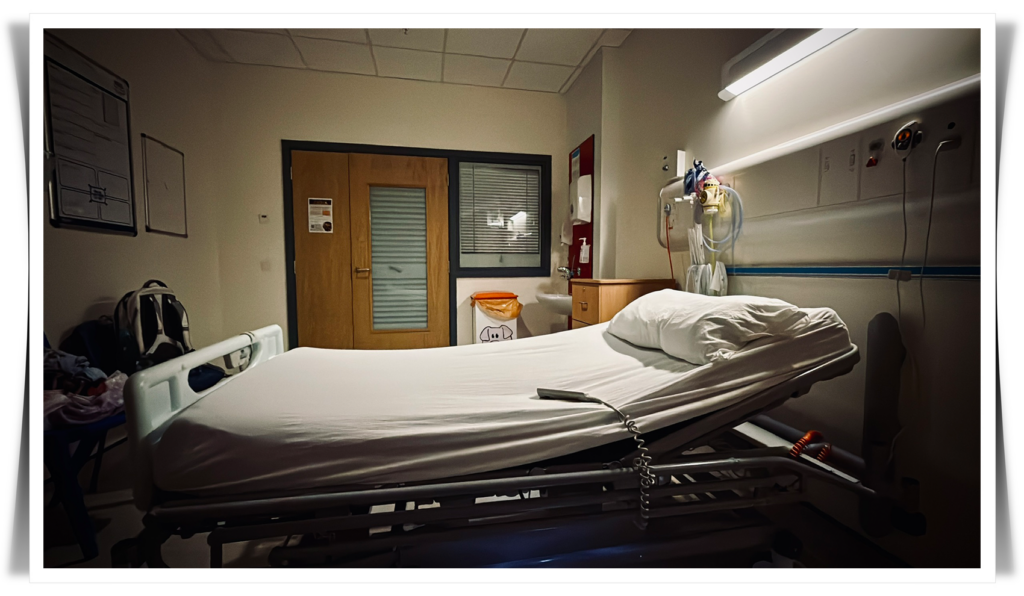
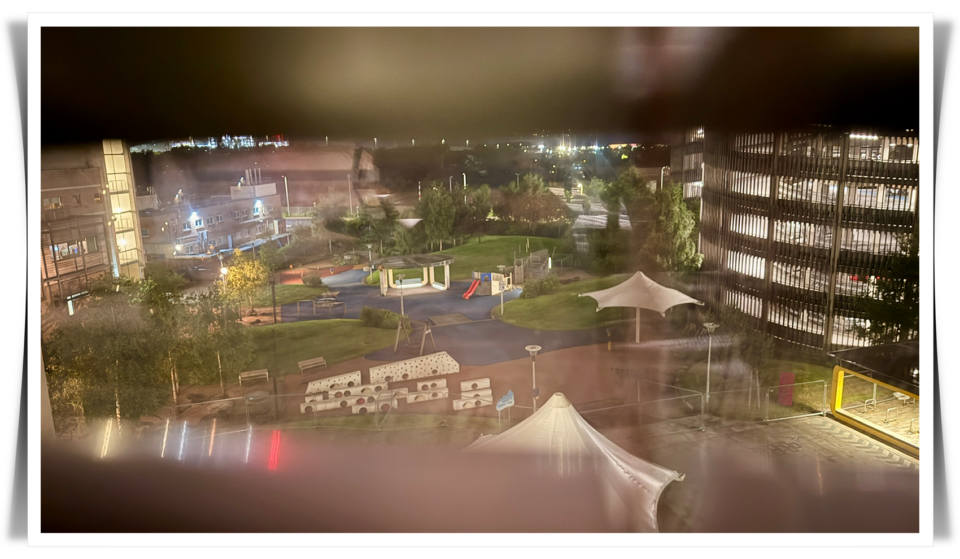
At 2.45 am on Wednesday the 8th of July, I sat down on the edge of the pull-down auxiliary bed in a dimly lit hospital room. Behind me, partially obscured by a set of half-closed blinds, the window gave a view of the campus grounds three floors below. In front of me, another empty bed stood in the middle of the room, head raised, illuminated by a reading light.
Sleep felt impossible. Instead, I sent a round of updates to family members and friends, telling them what was going on. Feeling quite alone, I suddenly wished I’d brought another cuddly toy: Flopsy had gone with Juliette, and rucksacks are much harder to anthropomorphise.
An hour went by, and then another. Initially, the surgical team had estimated 90 minutes, but 4.00 am came and went without a word. I couldn’t help imagining what might be happening in theatre: would they tell me if something had gone wrong? What if her heart had unexpectedly stopped? I leaned forward, elbows on my knees and chin propped against my knuckles, staring at the door. One of the ward nurses brought me a plate of toast with butter and jam, and another cup of tea.
Finally, at about 5.20 am, there came a knock. The ENT consultant and his colleague walked into the room, still dressed in scrubs. Their faces were bright, and full of relief. She’d done well, they said, and the surgery had gone as planned. They’d removed her mastoid bone, drained roughly twenty millilitres of pus from the abscess inside her skull cavity, and performed a myringotomy with grommet insertion to clear her middle ear.
There was something else, too. Instead of being compressed, her left sigmoid sinus had been fully thrombosed — completely filled with a septic clot. They’d decided during surgery to perform a thrombectomy to remove as much of the clot as possible, but some had been left behind to avoid damaging the wall of the sinus. With that major drainage channel still occluded, the blood flowing into Juliette’s brain would now drain out primarily via the sinus on the opposite side. Over time, and with the help of blood thinners, they hoped her body would remodel the remaining clot, allowing the blood vessel to recanalise. However, that would probably take several months.
This had been a life-threatening situation, they explained, and the operation had been essential. Now, she was in recovery, and I’d be able to see her soon.
I could have hugged both of them — but wasn’t sure if that was strictly protocol. Instead, I thanked them wholeheartedly for performing the surgery that had saved Juliette’s life. Words were inadequate, really. I felt more grateful than I could express.
Juliette’s ascent
Juliette arrived on the ward at about 6.30 in the morning. She wore a compression bandage over her left ear, and lay quietly on the bed with her eyes closed. After a few minutes, she began to wake up. By 7.30 am, she started complaining about the itchy bandage and her general situation: it was the most she’d spoken since the morning of the previous day.
We were not yet out of the woods. Her fever continued, and her headache didn’t immediately go away, either. Every few hours, antibiotics went into her midline by IV, and her team kept the painkillers going, including morphine. That afternoon, she went down for an MRI, which frightened her. I sat next to her at the bottom end of the machine and held her hands. At some point, it became obvious that she couldn’t really turn her head left.
Family came to see us that evening, bringing fruit, clothing and other essentials. Afterwards, I tucked her in with a pale blue hospital-issue thermal blanket, then made my way over to the fold-down bed.
“Mummy, can you lay with me,” said a little voice. And so I did, curling my body carefully around hers.
Very fortunately, the ward consultant that week was the ENT surgeon who’d performed Juliette’s operation. The next morning, he told us they’d isolated bacteria from Juliette’s bloodstream and were working to find out the serotype: streptococcus pneumoniae. Broadly speaking, the antibiotics she was on would be effective — but they were performing resistance testing to come up with a more targeted treatment. That evening, she unexpectedly developed double vision, prompting an extra visit from the team.
Another night passed, with the help of Oramorph. The following day, Juliette had her surgical drain removed. Her headache and double vision continued. After some on-the-spot tests, the consultant confirmed a minor sixth nerve palsy and referred her to the ophthalmologist that afternoon. Feeling somewhat uneasy about her ongoing headache, he also ordered another CT scan.
Juliette’s goal, that day, was to walk from her bed to the chair near the door. I held her hand and she made it over, then sat down for a while with a pillow behind her back, looking very solemn.
Time passed slowly. Juliette’s head pain came and went, while her appetite gradually increased. I carefully washed iodine and other surgical leftovers out of her hair with baby wipes while she watched television with one eye closed. In the evenings, we had mother-daughter hot chocolate parties with instant cocoa made in the parents’ room. I walked to Lidl and bought some marshmallows to put on top.
Three days later, her double vision resolved. After that, she wanted to explore, so I popped her in a wheelchair and took her to the playroom — but she stood up and sank to the floor. Abandoning that idea, I rolled her out of the ward and around the hospital atrium, which she named “the big, open space.”
Outside, Glasgow was enveloped in a heatwave. Sunburned hospital visitors wore shorts, and the main lobby began to feel like an enormous tropical palm house. My mum came to visit, and I went to the supermarket while she stayed with Juliette, returning with a summer dress and a pair of sandals. “Look,” I said. “You can wear these when you’re better.”
We began collecting snacks in the hospital kitchen fridge. After the parent’s room ran out of disposable cups and lids, a kindly housekeeper brought me a stash to keep. Feeling rebellious, I bought a real mug and a pair of slippers a few days later: if we were here for the long haul, I would have my creature comforts.
My dad asked what he could bring. “Things that will tempt a child to eat,” I replied — and he turned up with two carrier bags full of crisps and sweets, which we delightedly poured out all over Juliette’s bed.
The in-between
For her part, Juliette endured a lot. The anticoagulant injections she had every morning and evening burned, and her headaches were sometimes so bad that we put ice packs on her forehead. She hated the oral metronidazole because it made her feel sick, and found the sensation of the IV antibiotics unsettling. She still couldn’t turn her head left properly, and couldn’t hear out of her left ear. More than anything, she felt frustrated with her body and wanted normality to return. She wanted to run and play with her friends, but couldn’t.
Nine days after I brought her to A&E, we were able to leave hospital and go to a charity-owned flat nearby, fortunately paid for by NHS Highland. By this time, her team had switched her from injections to oral blood thinners. However, we had to return to the clinical decisions unit every day for antibiotics, so her midline stayed in. I worked remotely, sometimes from the flat, and sometimes from the hospital.
At first, I held her hand firmly everywhere we went. She’d lost weight while ill, had lingering headaches, and felt fragile and unsteady. To build up her strength and confidence a little, we drove to local shopping centres — quite the novelty for a kid raised on Kintyre — and rode up and down the escalators.
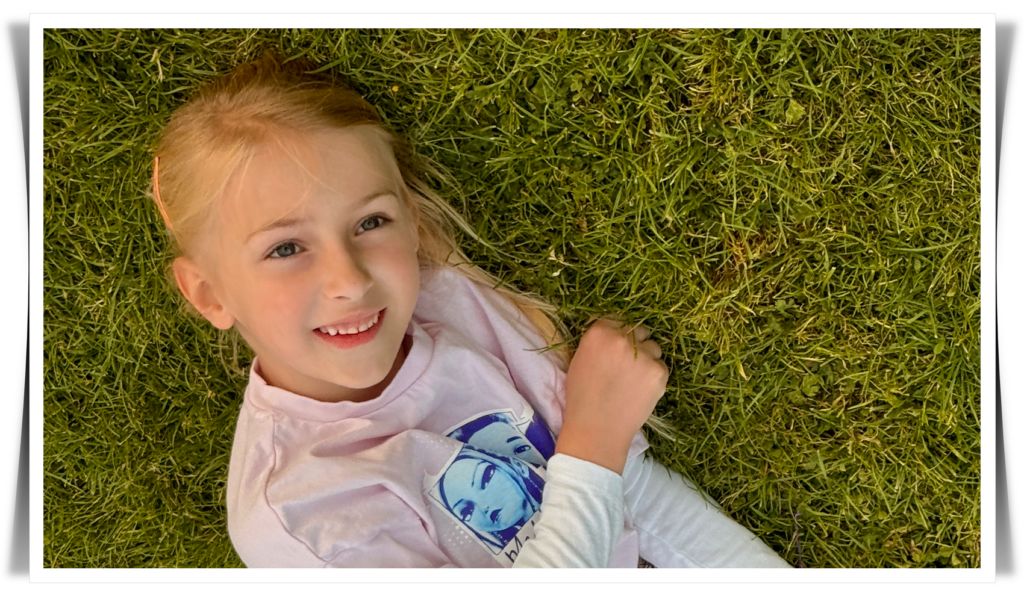
One evening, we visited Kelvingrove Park and walked along the river path to the museum. She lay down on the grass behind the big sandstone building, as if absorbing energy from the earth. When we got back to the flat, she went out onto the balcony and started singing to the people passing by. I listened, smiling. She hadn’t lost her spark.
Towards the end of July, she had a comprehensive hearing test. We’d hoped, based on the results of a Weber test conducted the day after her surgery, that she would retain the hearing in her left ear. However, she had a significant infection upon admission — including bacteraemia — which had taken a while to bring under control. The delicate structures in her inner ear had been affected after all, and her hearing was totally gone.
The news was sobering, but not a complete shock. Given the seriousness of her illness, it seemed fortunate that this was the only permanent consequence she’d walk away with. She was here, alive, with a future. We could deal with single-sided deafness if she could still run into my bedroom in the morning and give me a cuddle.
We made a plan: CROS hearing aids in the short term, and an Osia implant as soon as possible after that. The Osia would send vibrations through the bones of her skull into the cochlea on the right side; it wouldn’t restore stereo hearing, but it would allow her to hear sounds coming from the left.
Going home
In the end, we spent almost the whole of July either in hospital or temporarily living in Glasgow. After a final MRI on the 29th, which confirmed that while the clot was still present, it hadn’t moved, Juliette was officially discharged from the “hospital at home” service. The following day, we packed the car full of all the things we’d accumulated and left the city.
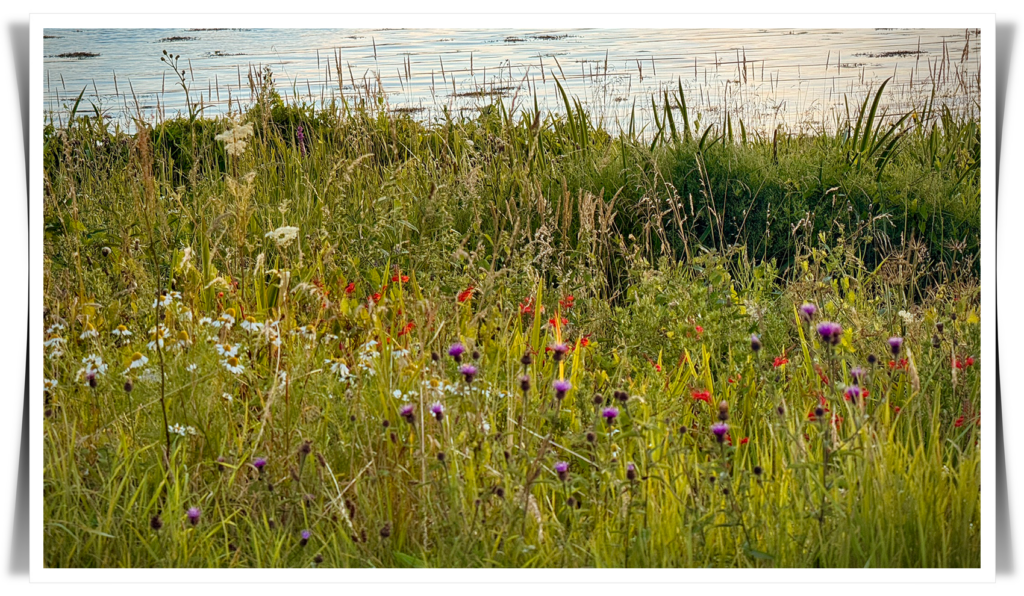
Driving back to Kintyre along the trunk road, I felt completely dazed. By the time we reached the peninsula, the afternoon had turned to evening, and the steep light made the land look especially beautiful. We got caught in the roadworks just north of Kennacraig, and while waiting for the hourly amnesty, I took a photo of the wildflowers outside my window. Juliette sat in the back with sunshine in her eyes, squinting across West Loch Tarbert at the Knapdale coastline.
We got home as the sun set behind the island of Cara. There were still medicine bottles sitting out, and a little rice heat pack I’d made for her on the sewing machine to help with her painful ear. The house needed a deep clean, but that would have to wait until morning.
That night, Juliette slept in her own bed, under her own duvet, surrounded by her menagerie of stuffed animals — including, of course, Flopsy. I lit a candle in my own room, and picked up The Odyssey from its spot beside my bed. Before Juliette’s illness, I’d reached the part where Odysseus, disguised as an old man and lodging with his shepherd, revealed himself to his son, Telemachus. Together, they’d made a plan to reclaim the kingdom of Ithaca. He had come home, as we had come home. Now, I had a kingdom of my own to reclaim.
___
I’m writing these words on October the 3rd, more than two months after the day we arrived home. This post has taken me the better part of two evenings to produce, and it’s probably far too long — but it’s been cathartic.
Sometimes, I still slip into a thousand-yard stare. I still feel dazed by all of it. I’m still grateful beyond words to the highly responsive and incredibly gifted team at the Royal Hospital for Children, without whom Juliette would not be here. Their prompt actions saved her life, and we are immeasurably indebted to them. They’re also absolutely lovely human beings and a credit to the hospital and to the wider NHS on that account, too.
Juliette continues to recover, diligently taking her blood thinners every morning and evening — and avoiding trampolines, just to be on the safe side. She’ll have a follow-up MRI later this month to see what’s going on with the clot. At some point, we’ll start making plans for her Osia surgery. In the meanwhile, life, thankfully, goes on.
___
If you’d like to help support the Royal Hospital for Children, you can fundraise, volunteer, or donate to the Glasgow Children’s Hospital Charity online.